Showing posts with label Driving. Show all posts

Wednesday, January 1, 2014

Naples

When we told people we were going to Naples, Italy, they kept asking “Why?” In short, we wanted to see Pompeii, and that means flying into Naples. We didn’t actually spend much time in Naples itself, but judging from the car window, it looks like the recession and austerity measures have taken their toll on the city. It was dirty; there was trash everywhere, and many buildings were vacant and boarded up. Also, the air was thick with the smell of smoke, all the time. And recently I learned why, the mafia has taken control of the trash situation in Naples, and is burning it around the city. When I think about this trip my feelings are pretty neutral. We had fun touring Pompeii and the other sites, but it was a very stressful environment; the good was tempered by bad.

We were cautioned against parking on the street as it increases the risk of theft. When the rental place gives you this information, you know it’s happened often. We actually saw lots of cars with broken windows. Furthermore, the drivers are completely insane. I heard more beeps over the weekend that I have in the past year, or even two years.

Traffic laws of any kind are completely ignored. At 20kmph over the speed limit, Joe was still being honked at like a little old lady. Lanes seemed to be optional and up for debate; cars and scooters constantly smushed into any space available. People passed in the intersections, went the wrong ways on roundabouts because it was faster, and drove in reverse for reasons unknown.

At any intersection stopping is frowned upon and hesitation is punished by repeated honking. You are expected to jump in front of traffic and hop for the best (continued survival and an unscathed car). For example, we were turning left from a side street onto a main road with heavy traffic. Our side street did not have a traffic light, so we were waiting for a break in the cars to turn onto the main road. In Naples, this is wrong; instead, the locals just go after a nanosecond pause, assuming the other people will probably stop.

This type of cavalier driving does in fact take its toll on the vehicles. I don’t think we saw a vehicle without any scratches or dents. Perhaps they don’t care about their cars. Or they haven’t realized that driving like maniacs results in vehicle damage. Either way it was the most stressful driving experience we've encountered – including driving in London on the opposite side of the road.

Useful Links!
Newsweek Article about the Trash Mafia

Friday, November 22, 2013

A Weekend on the Emerald Isle

Tullamore DEW Old Bonded Warehouse
Tullamore, Irealnd
On our first day in Ireland we drove across the entire country, coast to coast, and it only took 3 hours—Ireland’s not that wide.  We were driving from Dublin to the Cliffs of Moher. Along the way we stopped off in Tullamore to visit the Tullamore DEW whisky distillery. While in Scotland, I discovered that I liked Scotch, so I was eager to try some Irish whisky. Not particularly liking scotch, Joe was not as eager. There are many distilleries around Ireland. We chose Tullamore because it was on our route from Dublin to County Clare, it was cheaper than the Jameson tour in Dublin, and we’d heard of it.


Placemat for Tasting 3 Whisky Blends
Tullamore, Ireland

The Tullamore Dew visitor center opens at 9:30am and we arrived slightly before 10:00am. We inquired about tour times, but the text tour wasn’t until 10:20am. Since we didn’t have the time to wait around 30 minutes for an hour long tour to start we bought a tasting ticket instead for only €5.00. Before our tasting started we watched a little video about the history of the whisky, and then were walked through the museum on a personal mini-tour. Next, we tasted 3 blends of whiskies that were vastly different from scotch. They were also generous pours, Joe—the driver—didn’t finish his. Don’t worry though, no whisky was wasted on this tour; I finished his too.

The tour ended in the gift shop where all kinds of Tullamore DEW merchandise and whisky was available for purchase. There are 2 blends of their whisky that is only available in their visitor center. We wanted to buy a bottle, but I was hesitant to spend the requisite amount on whisky we hadn’t even tasted. Luckily, they had just opened a bottle at the bar, so I was able to taste it there with some of the bar maids. The 3 of us pronounced it delicious—Joe would just have to believe us—and we bought the bottle.

Useful Links!
Pictures from Our Trip!
Visit the Tullamore Dew Old Bonded Warehouse
Tullamore DEW Whiskies


Monday, November 11, 2013

Pemberley

Chatsworth House
Derbyshire, England
It took all day to drive from Perthshire back to London, but to break up the drive we stopped in the Peak District, at Chatsworth House. This is one of those grand British houses leftover from another time. The house is still owned by the 12th Duke of Devonshire, a peer of the realm. This is the kind of house in which girls dreaming of being Mrs. Darcy want to live. It’s fitting then that the 2005 Pride and Prejudice movie used Chatsworth at the set for Pemberley—Mr. Darcy’s home. There is also rumor that Jane Austen modeled Pemberley on Chatsworth when she was writing Pride and Prejudice.

The library at Chatsworth House
Derbyshire, England
I’ve seen the 2005 movie a lot, so I knew the house would be big, but standing before it, I was still amazed at its size. I couldn’t believe that it all belonged to one family—and I’ve been to several castles and palaces. Maybe that’s the problem; this building was palatial, but it was referred to as a house. At least with all the servants and generations living there, it can’t be called a single family home.

Bust of Matthew Macfayden as Mr. Darcy
Chatsworth House
Derbyshire, England
We were walking through my imagination; wandering the house, grounds, and gardens. It was a welcome break from the car. I particularly enjoyed seeing vistas from the movie, and there was a prop—a bust of Matthew Macfayden as Mr. Darcy—in the gift shop. The staff around the property was all very friendly and helpful; they were well educated on their surroundings and they could answer questions or participate in discussions about the artifacts or their owners with ease. Furthermore, the Peak district is a beautiful area and driving through it was a pleasure.


Useful Links!

Tuesday, September 3, 2013

Magical Mysteries

The Albert Docks
Liverpool, England
We left Birmingham early and drove to Liverpool to kick off our second day of travel. There were many things to do in this city but we were there to take The Beatles’ Magical Mystery Tour and to see the docks where my grandfather landed during WWII. The docks have changed a lot in 70 years, but it was still fun knowing we were walking in his footsteps.

I want it.
Penny Lane, Liverpool, England
The Magical Mystery Tour was crazy but it was a lot of fun. We boarded a very loud colored bus and drove around the city checking out sites that were tied to the Beatles; we couldn’t look more like tourists, not even if we wore visors and fanny packs. We saw their childhood homes, Strawberry Fields, Penny Lane, and the Cavern Club; our tour guide was even in one of the documentary films about them. When we visited Penny Lane Neil told us the sign was stolen so much when the song was new, the city decided to paint the street name on the wall instead; then people stole chunks of the bricks. Recently, the city decided enough time had passed, and they could put a sign back up; the signs now last an average of 3 days. I definitely wanted to return after dark with a wrench.

The Cavern Club is an underground music club that opened in the 1950s and the Beatles began frequenting in the 1960s. Over the years the club hosted many famous bands, and these are commemorated outside on the wall of fame; it truly is a piece of music history. Across the street is the Cavern Pub, a similarly decorated, underground pub serving normal bar food. When our tour ended we walked to the Cavern Pub for some lunch. The walls were covered with memorabilia from and photographs of dozens of artists. After lunch we briefly returned to street level before descending again into the Cavern Club.
The Cavern Club
Liverpool, England

Interior of the Cavern Club, with a Beatles Cover Band Playing
Liverpool, England
Other artists play at the club, but more often than not, there is a Beatles cover band playing, even at 3pm on a Thursday. My Dad was super excited to be there and was singing along with the band, oblivious to everything else. The group was two guys with guitars, and we kept trying to convince my Dad to drum for them. He refused, even after we bought him official Cavern Club commemorative drumsticks. We stayed down there, taking it all in, until they finished their set.

Approaching Malham Cove on the Pennine Trail
Malham Village, England
Emerging from the club we were greeted with sunshine. The storm from earlier had cleared and the weather was perfect for our next adventure: hiking to Malham Cove in the Yorkshire Dales National Park. Malham Cove is about 2 hours northeast of Liverpool and was the site of Harry Potter filming. The cover is a portion of land where a small creek has, over time, created a sheer cliff face; it’s like approaching a natural rock climbing wall. Peregrine falcons use the cliff face for their nests, and the whole cove is a haven for the birds.  The footpath through the area is called the Pennine Way; it’s part of a 267 miles trail through northern England. The trail ran through pasture land and was dotted with cattle and sheep; several times we changed fields and made sure to close the fence behind us lest the animals escape.

The sheer cliff face of Malham Cove; the colored spots are climbers
Malham Village, England
The real draw was at the top of the cove; water and wind have uniquely shaped the rocks into an eerie landscape. During The Deathly Hallows Pt. 1, Harry and Hermione camp on these rocks. It was a lonely spot in the movie, a perfect place to hide from Voldemort, but in real life there were lots of people climbing the face of the cove. Maybe the climbers come because of the movie and it was more desolate before, or maybe it’s always been popular.

I did not expect either of my parents to climb to the top; it’s a steep climb and it goes pretty high (260 feet), but they both did it. They didn’t stay up top very long, leaving us to explore a little more while they hiked back down. The entire hike we were serenaded by myriad wildlife including cows, sheep, and pheasant; Joe and I even found a flock of sheep on top of the cove. It was very pastoral and relaxing—I was reluctant to leave.

We regrouped at the bottom of the cove and decided to eat dinner in Malham Village; the Buck Inn was an easy decision as it was the only place open. The proprietors were very friendly and the food was delicious. While we were discussing the virtues of the onion rings the owner joked he could live on the onion rings, and I had to agree, though it would shorten both our life expectancies a bit. Before we came to Europe, everyone told us “Oh in [x] country they serve room temperature beer”. When in [x] country we would ask the locals and they would say, “oh no, not here, they serve it that way over in [y]”. We heard this about every beer drinking country, but until that night at the Buck Inn, all the beer was cold. At the Buck Inn we were drinking “Real Ale” or cask conditioned ale, which is unpasteurized, hand pumped beer served slightly below room temperature. So this would be considered warm compared to a cold, pasteurized, keg conditioned beer. The beer was more flavorful and less fizzy than keg beer, and I can appreciate the call for more “real” ales and ciders across Britain.
The steep Pennine Trail; perfect for sheep.
Malham Village, England

In addition to being a delicious pub, the Buck Inn is also an inn. My mom wanted to spend the night, but as tempting as it was, we’d already paid for accommodations in Newcastle, so we got back in the car after dinner. My dad was driving this leg, and to be honest, it was a little nerve-wracking—sorry Dad! We were following our Garmin, not the car’s built in GPS, and it was programmed to route us the fastest way. To calculate the route it uses posted speed limits, however if there is no posted speed limit it uses a default speed based on the road type. In the UK, the national speed limit on a single carriageway for cars in 60pmh unless otherwise posted. Using these default speeds the Garmin calculated that the quickest route to Newcastle was through the Yorkshire Dales Park. Unfortunately, we were not driving the default speed. The road was barely wider than our car and as it was through the national park, there were no street lights. To make our drive even more harrowing, there were also steep grade changes, 90⁰ hairpin turns, and no almost towns. Oh, also, we were running low on gas and the few tiny towns we drove through were all closed up for the night; yes the entire town was shuttered and dark. I could see the speedometer, so I know my Dad was only driving about 25 mph, but it felt like 70 in the dark and I spent most of the ride with every muscle in my body clenched in terror; I was very sore the next day.

Wednesday, August 21, 2013

In the Footsteps of Legends

The Cutty Sark Museum
London, England
When my parents came to visit we planned a week long excursion to the UK. After we landed in London we proceeded to pick up our rental car, but Sixt wasn’t located at Heathrow; we had to take a shuttle out to the lot. Our car was a black Citroen something or other; the standard European hatchback. Whenever we get a new rental car (at least every 3 months), it’s my job to fiddle with the dials and to figure out how the navigation system works. The nav system wasn’t very intuitive or user friendly so I switched to our handheld Garmin—a decision I would later regret. Perhaps to make up for its navigational deficiencies the car came with a bonus; there was a CD already in the player! It wasn’t just any CD either; it was The Beatles #1 hits CD. Naturally we put it on and drove through London feeling very authentic.

Best. Picture. Ever.
Cutty Sark, London, England

Our first stop was the Cutty Sark, a ship that dates from the height of the British Imperialist era, though it was in use until 1954. This ship has been in dry dock since 1957 and acts as a museum of English maritime history. It was a very hands-on museum and there were many exhibits for children and Joe. A lot of the ship is original; they’ve delineated restoration work with gray paint; original ironwork is white. Most of the boat was dedicated cargo space and the living quarters were cramped; the vessel was designed for making money. Throughout its eight seafaring decades, the Cutty Sark carried a variety of cargo, but I think the best time would have been when it was ferrying tea from China; this cargo would have smelled much better than wool from Australia.

Crossing Abbey Road
London, England
We then drove all the way across London to Abbey Road. We parked in an underground lot and witnessed a large queue of cars at the exit. A man was struggling with the automatic pay system and the mechanical arm wouldn’t let him out. Among those behind the man were an irate delivery truck driver and an anxious mother late to pick up her kids. Later, when we returned, the arm was bent at a funny angle; perhaps forced just high enough to let a car through. Abbey Road was once again packed with people, and since I’d already been there, I volunteered to stand on the island of safety and take pictures. 

My mom asked me to take this picture.
She said she hadn't seen clothes like this in awhile.
Oxford, England
Despite not sounding like much, due to the size of London and the abundance of traffic, these two visits took us past 3pm. We were spending the night in Birmingham, so after visiting Abbey Road we headed north. We stopped briefly in Oxford for dinner. Originally we were going to try to take a tour of the Bodleian library, a Harry Potter set, but we arrived too late to join a tour. Even if we had arrived on time, I don’t think we would have made the tour; Oxford University was having its graduation that day and there were gowned students and their families everywhere; surely the tour would have been full.


Instead, we delighted ourselves with looking at the old buildings and eating dinner in the Kings Arms Tavern. Almost every year my parents spend a week in Colonial Williamsburg, and one of their favorite places to eat is the Kings Arms Tavern where the food is prepared using colonial methods, and the staff wear traditional garb. Since Colonial Williamsburg is set before the American Revolution, technically both taverns are British. In the modern Kings Arms we learned British pub protocol; place your order at the bar, receive a number, and wait for your food to be brought to your table. I ordered a rabbit pie with cider. Mmmmmm. Meat pies in the UK tend to refer to a stew baked in a puff pastry pie shell; very hearty and delicious. It was an excellent conclusion to our first day in England.
My parents outside the Kings Arms Tavern
Oxford, England

Useful Links!
Pictures from Our Trip!
Visiting the Cutty Sark
Abbey Road Live Feed Camera - Watch the Madness
My Sister and I Visit Abbey Road
Oxfordshire (region Oxford is in) Tourism Homepage
Oxford City Guide
Bodleian Library Tours
Kings Arms - The Oldest Pub in Oxford
Kings Arms Tavern in Colonial Williamsburg

Tuesday, August 20, 2013

It's All About the Cars

Outside the BMW Museum
Munich, Germany
Hey everyone, it’s Joe here with another guest post. My brother Jason recently came out for a couple weeks and we did some tours of the BMW and Mercedes museums. Needless to say, Kelly wasn’t super excited about these events so I’m going to fill you in. We started off by visiting the BMW headquarters and museum in Munich. It was full of tons of gorgeous BMWs and Rolls-Royces (they are owned by the same company).
Airplane Engine
BMW Museum
Munich, Germany
They also have some awesome exhibits that display how their various models changed throughout the years and showed off their fancy new i8 prototype. Some have changed significantly since they originally built airplane engines… My favorite was definitely the 1956 BMW 507 but I will gladly take any car in the place and since BMW knows this they have a dealership with a test track right next door. We wandered over there and sat in some very expensive cars which was awesome. Jason even found 20 Euros but unfortunately that wasn’t enough to drive home in anything. :(
BMW 1956 507
BMW Museum
Munich, Germany


The Only Picture from the BMW Factory
Regensburg, Germany
A few days later we went on a tour of the BMW factory just outside of Regensburg and Jason got to see where his car was born. It was like being in an episode of How It’s Made! It was so cool to go behind the scenes and watch these giant machines toss around cars like they were nothing. Unfortunately no pictures were allowed so you will just have to visualize it in your head. We walked through the entire process of building a car from stamping out pieces from aluminum sheets to painting and installing the entire custom interior. Their factory produces about a car a minute and because of the cornucopia of configurations they typically only create 2 identical cars per year. That’s a lot of customization! Also while we were there our tour guide decided to fill us all in on what BMW stands for (apparently it’s not common knowledge). For those of you who don’t know it stands for Bayerische Motoren Werke in German but for some reason our guide translated it to Bavarian Engine Plant in English explaining that it was actually BEP in English. For the life of me I can’t figure out why she didn’t just translate it to Bavarian Motor Works which would keep the BMW acronym intact. It makes no sense!! Anyway, after our tour they gave us a bunch of brochures for building our very own BMW and even let us take some pictures with a few of the finished products.

1886 Benz Patent Motor Car
Mercedes Museum
Stuttgart, Germany
Our last stop on the cars of Germany tour was the Mercedes museum in Stuttgart. This museum had a very different focus than the BMW museum. The BMW museum focused on showcasing their cars and filled the rooms with as many as possible. Mercedes was more centered on providing a timeline of the development of the automobile and displayed cars that represented certain parts of their history. They also provided you with information about the world during various periods so you understood what was happening as Mercedes was producing cars. BMW also had a room with that went into their detailed history but it really wasn’t their main focus. The Mercedes museum started in the obvious spot with the invention of the automobile “by” Karl Benz. The reason for the quotes is that Karl Benz is remembered as the creator of the automobile based on a technicality in my mind. Gottlieb Daimler and Wilhelm Maybach actually created the first internal combustion engine small enough to power a car and they retrofitted it into a carriage. Benz is more remembered because he built a vehicle around the engine (rather than adding one to an existing carriage design) and filed a patent for his creation.
1935 Mercedes Benz 500K Special Roadster
Mercedes Benz Museum
Stuttgart, Germany
It’s always amazing to find out some common knowledge isn’t so common. Throughout the rest of the museum Mercedes showed off all of the types of vehicles that they make from luxury cars to buses to the popemobile and even hydrogen fuel cell vehicles. All in all, we enjoyed exploring both museums but I would still pick a BMW over a Mercedes.
1980 Mercedes Benz 230G Popemobile for Pope John Paul II
Mercedes Muesum
Stuttgart, Germany


Useful Links!
Pictures from BMW in Munich
Pictures from Mercedes in Stuttgart
Mercedes Museum Visitor Information
BMW Welt (World) in Munich Visitor Information
BMW Plant in Regensburg Visitor Information

Wednesday, July 3, 2013

Road Trip pt. 2: Croatia

Plitvice Lakes National Park, Croatia
I almost don’t want to write about this part of the trip, because if I write about it, I’ll be encouraging you to visit a pristine place, and I like that it’s relatively unknown. Plitvice Lakes is a national park in Croatia and has been in existence since 1949, but they haven’t even had 2 million visitors yet; their 1 millionth visitor arrived in 2011. In 2011 alone, Yellowstone had over 3 million visitors and the Grand Canyon had over 4 million visitors. Plitvice Lakes is stunningly beautiful, and it still looks like the pictures on its website, unlike other destinations where fellow tourists are thick as ants on a cookie crumb. We were able to walk for an hour at a time without encountering more than 10 people, or thankfully, any bears. There is a population of endangered brown bears that lives in the park, but I think they keep to the more densely forested areas away from people.

Plitvice Lakes National Park, Croatia
In the 90s, Croatia was part of Yugoslavia and embroiled in a bitter civil war. When the war ended, Croatia, Bosnia Herzegovina, Slovenia, The Republic of Macedonia, Montenegro, Serbia and Kosovo emerged. There are actually still unmarked landmines throughout the country; to avoid catastrophe stick to well-marked areas that have already been cleared. War tends to deter tourists, and they’re just beginning to come back, even amid the warnings to watch out for land mines. Many visitors, especially those from cruise ships, tend to stick to the Adriatic coast and avoid the interior of the country. Plitvice Lakes is not only located in the middle of the country, but also the middle nowhere.

The wooden paths went right over the water; visible beneath my feet.
Plitvice Lakes National Park, Croatia
Getting to Croatia seemed easy enough, but we got hung up at the border crossings. Our route took us from Austria, through Slovenia, and finally into Croatia. To drive in Austria and Slovenia you need two separate vignettes; window stickers valid for a period of time that serve as road taxes. Even though we had vignettes though there were still hefty tolls on the roads; road tripping through Europe is not for the weak of mind, stomach, and wallet. At the Croatia border we had to go through customs, and we got our passports stamped—YES! Instead of an airplane, the stamp had a car on it since we drove to the country. We visited on the 21st of May, and at that time Croatia wasn’t a member of the EU, hence the official border crossing. They officially joined the EU on the 1st of July and now has fluid borders with other EU member states.

Crystal clear water at Plitvice Lakes National Park, Croatia
Croatian food is AMAZING!!! The region has been influenced by so many cultures throughout the ages, and the food reflects this. There were Greek and Turkish influences with a hint of Mediterranean on a base of more continental fare like pork and game meat. We had a baklava for dessert that was drenched with perfectly sweet honey, and it was to die for.

We spent the entire day (9 hours) in the Plitvice Lakes Park. The trail took us along the top of the river gorge and down to the water level. Sometimes the wooden-plank path would over a lake or waterfall and we could see the water rushing right below our feet. I could go on, but the pictures really speak for themselves.
Plitvice Lakes National Park, Croatia

I would love to return to Croatia to explore more of the beautiful country and its delectable cuisine. Even though doing so will increase the touristy aspects of the country, I urge you to go to Croatia and spend more than the few hours allocated to a cruise ship shore excursion. It will be worth it. Just watch out for landmines and bears; stick to the well-marked path.

Useful Links!

Friday, April 26, 2013

Farther Afield

This is always a topic in the guidebooks; they run through the sites of the major city you plan on visiting, and then they mention things farther afield. These sites are at least 40 minutes outside of town and usually best reached by car, thereby eliminating many potential visitors.

Everything is Opposite!
For our UK trip we decided to make the one of our days a farther afield day. Our stops were to include Stonehenge, Lulworth Cove with its Durdle Dor, Winchester to see King Arthur’s Table, and Jane Austen’s home, Chawton Cottage. We would need a car, so we arranged to pick one up the night before we departed on our adventure.

Just a reminder, in case it slipped your mind, in the UK, they drive on the left side of the road. In case that wasn’t confusing enough, they drive on the right side of the car. Our rental car conformed to British standards and provided us with endless amusement because it was a black Volkswagen Beetle. Punch buggy! It was very bizarre being a front seat passenger on the left side. Turning was mildly terrifying, but Joe deserves a lot of credit for driving around both London and the countryside without killing us or anyone else.
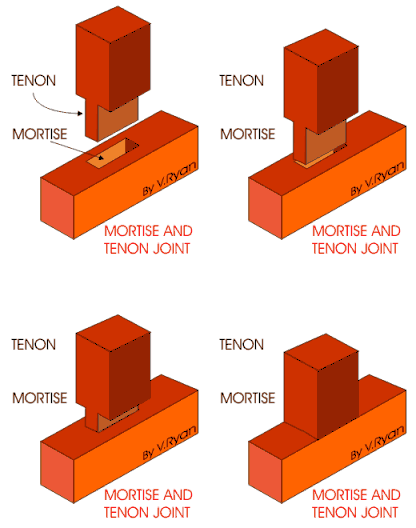
Image from The Mortise and Tenon Joint-The Mortise
Available from this website.
When researching Stonehenge, I learned for an additional fee, you can visit the stones before the attraction opens or after it closes to the public. During this visit you do not have to pay for parking and you have free range of the park; you can walk all around the stones and inside the circles, so long as you do not touch or climb on the stones. Since Stonehenge was our first stop of the day, I requested morning admission. Our request was approved, but we were assigned to the earlier time slot: 6:45am. To ensure a timely arrival at the park we needed to depart London around 4:30am. This adventure could not have happened without advanced, pre-booking. I realize that sounds redundant, let me clarify, this needed to be booked months ahead of time, not hours or days. Like at the Vatican Necropolis, the English Heritage controls the number of visitors to protect the site.

When I booked our tickets, I also reserved a guidebook; arriving at 6:45am meant the gift shop would not be open; there would be no one site purchases. However, when we arrived, there was no guidebook; no one remembered to set one out for me the previous evening.

The stone on the left clearly has a tenon showing.
Stonehenge, Wiltshire, England
When Stonehenge is closed to the public, the only staff members on site are the security guards. Because of the incident with the guidebook, we were directed to the head guard, Brian. He apologized profusely, and accepted responsibility for the error—not something done frequently. As recompense for the mistakes made, he offered to answer any of our questions, and act as our personal guidebook. Brian was very knowledgeable, and had spent time with (presumably supervising) various archeologists during their digs in the area.

Inside the red circle is the signature of Christopher Wren
Stonehenge, Wiltshire, England
The first question out of Joe’s mouth was “So the aliens made this, right?” Brian promised to definitively prove that theory false by showing us examples of human error. The outer ring at Stonehenge is made with local sarsen sandstone, hence calling the largest stones sarsens. These were arranged into the iconic trilithons, two upright posts capped with a lintel stone. The stones are joined with two types of joints, mortise and tenon to join posts to lintels, and tongue and groove to join lintels and link up the trilithons. In the thousands of years since its construction, some of the trilithons have fallen and come apart. On one dissembled trilithon, the round tenon is clearly visible. Brian then showed us the corresponding lintel with the mortise groove; on one side of the lintel, a mortise was started, but never finished; the finished mortise was on the other side, clearly demonstrating human error. This definitely demonstrates an error, and “to err is human”, but who’s to say aliens don’t make errors as well? Brian definitively proved the people (or beings) that made the stones were imperfect, but do only humans err?
An ax head is clearly visible here, next to a dagger.
Stonehenge, Wiltshire, England

Having Brian act as our guide was wonderful; he pointed out details we would have missed if we had been exploring on our own. A curiosity he brought to our attention was the ancient and antique graffiti, including a few marks thought to be left by Sir Christopher Wren, architect of St. Paul’s cathedral in London. There are also over 100 ax heads carved onto the surface of the stones. These are thought to be from the Bronze Age, and may indicate the site of burials or cremations since the ax head has long been associated with various deities.


Lichens on one of the fallen stones
Stonehenge, Wiltshire, England
Much to my sister’s and my amusement, there were dozens of sheep scattered in the fields around Stonehenge. Brian explained the sheep are quieter and more picturesque than lawn mowers, so they are used to keep the fields cropped, but they aren’t allowed up near the stones. We asked why, and the response we received was surprising; the sheep eat the lichens on the stones. When the lichens are removed (or eaten) some of the top layer of stone is removed as well, opening up the under layers to abuse from pollutants and weather. There are also rare and endangered lichens on these stones, including a variety usually found only in salty areas, but for some reason, this halophile has thrived some 30 miles inland.

Stonehenge, Wiltshire, England
The morning was hazy and windy, and when Brian finished showing us around, my sister and I huddled behind a stone, trying to block the wind, and we observed the other people around us. There was one guy doing something a little strange. First, he had a small pouch on a string that he was swinging around, like a priest with frankincense. Then he had some L-shaped rods he was holding; they were like metal TV antennae and he was holding one in each hand by the short part of the L. Joe asked him about it, and they were dousing rods; they moved back and forth when they detected energy. Outside the circle the barely moved at all, but inside, toward the center of the circle, they wriggled much more. According to Joe, the craziest part was, the two rods moved completely independent of each other.

Assuming the rods were actually working, and really detecting energy, perhaps it’s residual from the henge’s first use. I watched a documentary on the history channel about how the area was used as a celebratory area for death and rebirth; it’s no coincidence the circle lines up with the sun on the summer and winter solstices. Or maybe the energy isn’t residual at all; Wiccans still regularly conduct ceremonies here. Either way, Stonehenge is still full of mysteries that scientists are continuing to unravel, even as you read this.

Stonehenge, Wiltshire, England

Useful Links!
Pictures from Our Trip!
Article Discussing Reasons Behind Stonehenge's Location (This is recent, from April 2013)
Article About the Lichens on the Rocks at Stonehenge
Stonehenge at History.com
Stonehenge at Sacred Destinations
Map of Stonehenge from English Heritage
Stonehenge Laser Scan: Archaeological Analysis Report (This was interesting)
Summary of the Above Report if You Don't Want to Wade through the Scientific Jargon (Bear in mind, the report is better)
Theories About Stonehenge
History of Stonehenge
National Geographic Article about Stonehenge
Smithsonian Magazine Article about Stonehenge
About Mortise and Tenon Joints


Tuesday, November 27, 2012

Hellacious Bus Ride


Our adventure to Italy began at 9:45pm on Tuesday. We boarded a bus with less space than a modern airplane, and proceeded to head south for 12 hours. Not being a great sleeper myself, when I was unable to get comfortable, I just sat there wishing the hours would fall away faster. Luckily, the bus stopped a couple times, and we were able to get out and stretch our legs or purchase something to drink. Our bus also came equipped with a tiny closet of a bathroom, right across the aisle from our seats. So in addition to not being able to sleep I also got to listen to the squeaky door rattle all night, as well as my fellow riders making frequent trips to toilet. Upside, no vomit, and no deuces.

Shortly after sunrise, we stopped at an Italian rest stop for breakfast. Before we left, I had examined the itinerary, so I knew that we weren’t checking into the hotel, and were jumping right into touring. Joe and I brought our toothbrushes, and I brought a change of clothes; we were almost refreshed. However, the bathroom where all this freshening was supposed to occur was outside. In a trailer. The real bathroom was under construction. Oh, and the doors weren’t clearly marked so men kept walking into the women’s room. Awesome.

The rest stop was packed, and it consisted mostly of grab and go cold sandwiches. Nothing we were really excited about, so we decided to pass. We did grab some drinks and ate some poptarts for breakfast on the bus.

After everyone boarded we set off for Pisa. 


Monday, October 15, 2012

Upcoming Trip!

During Thanksgiving, most people have days off, as it's a Federal holiday. However, as we discussed last year, Germany doesn't celebrate Thanksgiving, so everything is open! This year, Joe and I have signed up for a trip scheduled by the base MWR (Family & Morale, Welfare, and Recreation). We're going on a 4 day trip to Italy! I've included our itinerary here since we'll be keeping our activities cheap in the run-up to the trip.


Day 1: Departure from Germany

Day 2: Pisa City Tour
We will stop for breakfast at a highway restaurant. After breakfast, we will arrive in Pisa for our city tour. The tour includes a stop to the famous Leaning Tower of Pisa. Free time will be provided to ascend the leaning tower or to visit other sights Pisa has to offer. Sights in the city worth visiting include the cathedral, botanical gardens, museums, Piazza del Duomo, Museo del O’Pera del Duomo, field of miracles, treasuries, and the baptistery. After a nice relaxing lunch, we depart Pisa for our hotel in Gragnano, a small village near to the city of Lucca for some needed rest and relaxation. Dinner is served in the hotel.

Day 3: Montecarlo Hiking/Fortress Tour, Lunch/Wine Tasting, & Free Time
After breakfast, the hotel director will take the group on a 5km hike from the hotel to the town of Montecarlo. We will hike through a scenic landscape of oak trees up to the village and the medieval town fortress. The trail then takes us further into Montecarlo at a local Fattoria. A wine tasting is included during lunch. Afterwards the bus will depart for free time in Lucca.

Day 4: Florence City Tour & Free Time
We will depart our hotel after breakfast for the Renaissance city of Florence. In the morning during our city tour we’ll see the city’s highlights by bus from the outskirts, and then walk its medieval streets by foot. We’ll see famous Ponte Vecchio Bridge with the homonymous Palazzo as well as the largest Franciscan church in Italy, Santa Maria Croce, which is considered to be the burial site of some of the most influential Italian people from history, art, and literature. Also impressive is the Palazzo Vecchio in the Piazza della Signoria with the replica of David by Michelangelo. Other attractions include the octagonal Baptistery dedicated to the patron saint of Florence, San Giovanni, and the Palazzo Medici Ricardi. Free time will be provided in the afternoon to purchase souvenirs, or visit a museum.

Day 5: Lucca Tour, Market visit with Chef, Olive Oil Tasting and 4 Course Dinner
Today, a special experience awaits you. The hotel chef will take us to Lucca to shop for the ingredients for our 4 course Tuscan dinner. The Lucca fruit and vegetable market is well known for its Tuscan food. Our hotel chef will explain his purchases, and you have the opportunity to ask questions and maybe suggest an ingredient he should buy for the 4 course dinner. In the afternoon, there will be a brief tour of Lucca. During our tour, you will see the impressive Piazza del Mercato, where a Roman Amphitheatre was located. Also worth seeing is the Piazza San Michele with the Church of San Michele in Foro and the Palazzo Pretorio. In the late afternoon, we take our bus to outskirts of Lucca for an olive oil tasting.

Day 6: Return to Germany

Saturday, September 22, 2012

Czech Out our Prague-ress!


While Joe and I waited for the living-in-Germany-long-term paperwork to clear all the government offices, I busied myself with various crafting projects and research on European travel. I have compiled, and am still in the process of finishing, a list of destinations across the continent that I feel would be fun to visit. Furthermore, I’ve researched the sights found in the cities we’ll be traveling to, and copied down their opening hours and websites. I gathered my information using guidebooks from my local library and then conducted further research online. This has made our traveling easier. Before when we wanted to take a trip, I cast about for an idea on where to go, and then spend hours researching what to do once we got there. Now, I’ve narrowed down the time I have to spend on the internet before we travel.

On September 14 we drove up to Prague, in the Czech Republic, for the weekend. The drive was only about 3 hours from Regensburg and part of it included the autobahn, so Joe enjoyed driving fast. Before we reached the border we needed to pick up a vignette. You place these little stickers on your windshield, and you are permitted to drive in the country. Since our trip was short we only bought the 10-day pass, but there were options for 3 months and 1 year as well. These stickers are available both at gas stations near the border and at the border crossing itself. The Czech Republic is part of the European Union so our passports weren’t checked and our vehicle wasn’t searched, we just drove right under the vignette scanner (like EZ-pass in the states) and continued on our way. Being prone to usefulness, I fell asleep. Wait, I meant uselessness. When I woke up, we were almost in Prague. As we got closer to the center of the city, the highway became crowded with more and more billboards. I don’t mean billboards every 100ft or so, I mean so many billboards it became difficult to distinguish the ads from the signs. From one spot on the highway, we could see 20 or so billboards at once, plus traditional road signs. It’s very overwhelming to be bombarded with so much advertising when trying to find your way in a strange city, though I imagine it’s probably overwhelming at all times.

Beer Tour Brochure!
During the drive, when I wasn’t sleeping, we spent some time with our European phrase book. This book is pocket sized, and we bought it before we arrived because it has almost all the European languages in it. There were a couple times were Joe asked me to look up a word, but I couldn’t find it, because as it turns out the book is mostly concerned with food, identifying it, obtaining it, and eating it. There were also a few handy phrases for getting by, like do you have a fax machine? And where is the nearest phone booth? We settled on learning these phrases to help us: Mluvite anglicky, pronounced mlooveeteh anglitsky, means do you speak English? DobrĂ½ den, pronounced dobree den, is good day. Ahoj, pronounced ahoy, means hello and is incidentally my favorite Czech word. Joe had trouble with every phrase except ahoy, but he claims it’s because he didn’t have the opportunity to read the phrases like I did.

After a couple (possibly illegal) u-turns and some vague directions from our British GPS system we arrived at our hotel, the Best Western Bila Labut, which means white swan. The woman behind the front desk was very helpful and spoke fluent English, so unfortunately we didn’t have an opportunity to use the Czech phrases we had been practicing in the car. There was also a brochure stand. I love brochures! They make my job easy. Since we arrived near to 6pm, all of the attractions I had bookmarked for our visit were already closed, but the brochures identified a beer tour starting at 6:30 and decided that touring microbreweries would be a great way to start the weekend. 

Saturday, December 17, 2011

Carriageway Travels


Our GPS will occasionally call the highway the carriageway, and say things like, turn half-right and follow the parallel road. These directions can be a little confusing to follow, as the amount of roads in an area can make the directions ambiguous at best. We’ve spent a good deal of time traversing the carriageways in Southern Europe and there are great disparities between the rest stops.

Two particular examples come to mind as the best and (hopefully) the worst, in Belgium and France respectively. The others fall somewhere in the middle with no outstanding features which warrant your attention.

In France, I found myself in need of a restroom, so we pulled over at the next rest stop. It was little more than a bathroom with an area to park. The sign on the building indicated the water was not potable, and advised us not to drink it. Inside, the women’s room brought back memories of the old chicken coop on my Grandmother’s farm: stinky with years of feather and bird poop residue. The sink/counter area was crowded with trash, and the whole place had a grimy atmosphere. I approached a stall and opening the door found a hole in the ground, surrounded by a sloped metal area, which I assumed caused excrement to drain back to hole, much like a shower. Considering the squalor surrounding me, I was pleasantly surprised when I found toilet paper. A few moments into the proceedings, water began running across the metal floor to clean the hole in the ground. I said a silent prayer of thanks, as I had considered planting my feet where the water was now running, and I would not have been happy with non-potable, hole-rinsing water on my feet. Perhaps the worst thing about this bathroom was the knowledge that Joe had a real toilet to use. Maybe someone switched the signs? Men seem much more adapted to peeing in a hole than women.

In Belgium, we stopped for dinner at the rest stop that advertised its Pizza Hut. We were hungry and still not close to our destination, and as it was Sunday, there was no guarantee of anything being open when we did arrive. It was night, so we could not see the size of the building we approached, and were surprised when, shortly after entering, we had to ride an escalator. At the top was a very large and well kept dining area over the highway. It was designed like a ski chalet with a slopped roof and windows in the side. The bathrooms had numerous stalls and were clean: they even had a Dyson air jet hand drying machine–love those.
Guests had several options for food, including the Pizza Hut specials, or selecting items from the buffet line. Fresh fruit and vegetables were available, as were homemade desserts and salads. To drink, you could select from the usual line of beverages, or you could opt for some beer or wine. Joe and I felt that selling alcoholic beverages at a rest stop was a little odd, as everyone had to drive to get there, but they acted as though this were normal. The food was delicious and reasonably priced, and in short time we found ourselves back on the road.

I don’t think there is any way to predict the quality of your rest stop before arrival, but I recommend choosing one that has a restaurant, as they will most likely have actual toilets. 

Monday, December 5, 2011

Confoederatio Helvetica


CH is Switzerland’s country abbreviation because of its full Latin name, Confoederatio Helvetica, which means the Swiss Confederation. The Swiss are famous for many things, further adding to their diversity. Switzerland has 4 national languages: French, Italian, German, and Romansh. Sadly, we know none of these languages, so the increased number of communication options did not help. However, as with many places in Europe, nearly everyone we encountered spoke English.

The Swiss people are staunchly neutral and have not been involved in an international war since 1815. Somehow, they even managed to avoid invasion during both world wars. In adherence to this neutral policy, Switzerland is not actually part of the European Union. It does participate in many of the economic measures adapted by the EU and allows for fluid border crossings, but the country maintains its independence, and its own currency: The Swiss Franc.

To enter Switzerland by car, as we did, you need a special sticker, called a vignette. As handy as our GPS is, it is not stellar at telling us where one country ends and another begins. The international borders are very faintly drawn and not labeled, so they appear as roads. As such, we were taken by surprise when a Zoll (customs) booth appeared seemingly out of nowhere. We did not have the sticker, and had to stop so a customs officer could examine the vehicle. The customs agent seemed especially puzzled by the box of Cheerios in the back until I explained that we bought it on an army base. Shortly after, he realized Joe worked with the military, and stopped searching the car. This may have been because he was finished, or because he felt that he did not need to continue. Stopping actually worked out in our favor, as we were able to buy the sticker and change our Euros into Swiss Francs. Unfortunately, they did not have any stamps so they could not stamp our passports, though I like to think they would have if the stampers were there. 

Sunday, November 6, 2011

German Cars

In the US if you drive a BMW, people automatically make certain assumptions about your income and personality (rich prick). However, in Germany, BMWs, Mercedes, and Volkswagens are EVERYWHERE. The semi-trucks are made by Mercedes. There are BMW station wagons and minivans for the soccer moms, sorry football moms. Furthermore, these vehicles like to go fast. They were designed to be driven on the autobahn, which in some areas literally has no speed limit. Lest they disappoint the cars, the owners drive them fast. Joe has been enjoying the luxury of driving as fast as he wants, but no matter how fast we drive, there is still someone driving faster than he does. So far, this trip he topped out at 218kmh, which is 135mph. The funny thing is, the car does not object to this handling. It does not whine, the road noise is bearable, the ride felt smooth. Almost makes me want a BMW to cruise around in back home. We will see.

A Leisurely Drive


Regensburg IKEA
Regensburg, Germany
On Friday, Joe came home from work early, maybe 1:30 local time. As we needed some new pillows, we went to the local (local!) IKEA. Man I love this store, in all languages. It is so awesome. We wandered around and found some furniture from our old apartment, priced out some futons for when guests come to visit, and got a few things we felt we needed. Joe picked up a bigger cereal bowl, I got a bigger teacup, and we got a bigger casserole dish. I cannot make Thanksgiving dinner in a dish that will not hold even a leg of turkey. We also grabbed some hangars and some actual useful pillows.

Kurnberg, Germany
After we left IKEA, we drove around the outskirts of Regensburg. We learned that 5 houses can comprise a village. In Kurnberg, one of the locals waved at me as we passed. We were in lots of farmland and forests. The leaves here are changing and it is quite beautiful.

We later ended up in Burglengenfeld. We were taking some pictures of the town, when an old man approached, and started telling us about the history of the town. He was very well spoken and very knowledgeable of the area. He told us that the castle on the hill was made of fire-stone which is not mined in the area, but there is a quarry in Tel-Aviv. He thinks the Romans had Jewish slaves cart the stones here to Burglengenfeld. I did enjoy listening to him tell us stories, and considering I thought he was going to ask for money, I was pleasantly surprised when he just wanted to chat, and mad at myself for making assumptions about him. 
Burglengenfeld, Germany